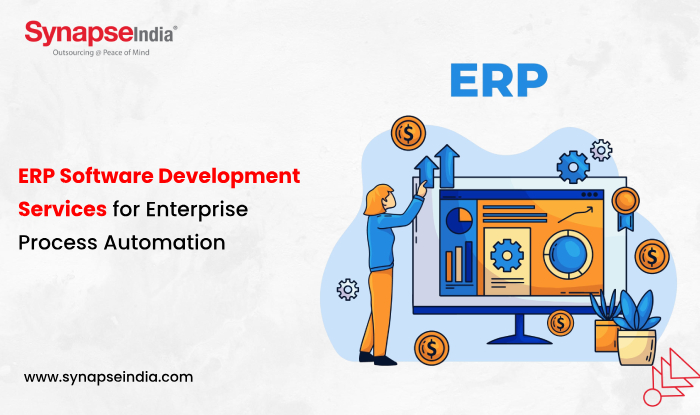
ERP Software Development Services: Key Features Modern Businesses Need
 16 Jun 2026
Edited On: 08 Oct 2026
Quick Summary
- Purpose: Show modern businesses which ERP features actually move the needle not a checklist, but what separates systems people use from systems they work around.
- Key Benefits: No more digging through three different spreadsheets just to make a simple call. Data you can actually trust. Less stuff slowing your team down day to day. And a system that grows with the business instead of holding it back.
- Target Users: Mainly ops heads, CTOs, and owners trying to figure out if ERP software development services are worth the money before their next big platform decision.
- Market Trends: In 2026, off-the-shelf ERP is losing ground to businesses that realized the template never fit their actual workflows.
- Result: An ERP either becomes the operating system your business runs on or the one everyone works around. Not much middle ground exists between those two.
Most businesses do not fail at ERP because they chose the wrong software. They fail because they chose software built for a generic version of their industry and then spent years bending their operations to fit a system that was never designed for them in the first place.
The symptoms are familiar. Departments working from different spreadsheets. Approvals living in email threads nobody can trace back. Reports that take half a day to build and are already outdated before they land in the right inbox. Shadow systems that everyone uses and nobody officially acknowledges.
This is not a people problem. It is a system problem. And the businesses getting it right in 2026 are not buying their way out of it, they are building their way out.
That is the difference custom ERP software development makes when it is done properly. Not a platform you adapt to, but a system built around how your business actually runs. Here is what that looks like in practice.
Here's what that looks like in practice. For Steve Madden, we built middleware connecting Shopify with their ERP, WMS, and returns systems across six countries, cutting order processing time by 80% and manual intervention by 70%. You can read the full Steve Madden case study here.
Packaged ERP works until workflows get specific custom pricing logic, unique approval hierarchies, compliance requirements, integrations the vendor never anticipated. Those gaps get filled with spreadsheets and shadow systems nobody sanctions but everyone depends on.
That patchwork costs more long-term than building something that actually fits. The global ERP software market is projected to reach USD 123.41 billion by 2030, growing at a CAGR of 9.8% (Grand View Research) , a figure that reflects just how many businesses are actively moving away from patchwork systems toward purpose-built solutions. B2B ERP solutions built around real operations handle the actual workflow instead of a simplified version of it.
Key Features Modern Businesses Actually Need
| Feature | What It Replaces | Business Outcome |
| Real-Time Data Across Departments | Siloed, delayed reporting | Decisions on current information |
| Modular Architecture | Bloated all-or-nothing platforms | Pay for what you use, add what you need |
| Custom Workflow Engine | Manual approval management | Requests route and escalate automatically |
| Third-Party Integration Layer | Duplicate data entry across tools | All systems talk to each other cleanly |
| Role-Based Access Control | Shared logins and data exposure | Right people see the right information |
| Embedded Analytics | Weekly manual report builds | Insights available without asking IT |
The Features That Actually Define Whether an ERP Works
"The most expensive data in any business is the data two departments are looking at differently. ERP's entire job is to make sure that never happens." By Operations Technology Review, 2025
Real-Time Data That Everyone Actually Trusts
The most common ERP failure is not technical. It is departments working from different versions of the same data finance on yesterday's numbers, sales quoting on inventory that moved three days ago.
When data updates in real time across inventory, finance, HR, procurement, and sales, decisions stop being made on stale numbers. Fewer errors, faster responses, no more meetings spent reconciling which figure is actually correct. Any serious ERP software development services provider builds real-time sync into the architecture from the start.
Modular Architecture That Grows With the Business
Businesses pay for packaged ERP features they never use while missing the functionality they actually need. Modular architecture fixes that start with finance, inventory, and HR, then add manufacturing, analytics, or field service modules as operations grow. Each piece connects to the same data layer without a separate implementation. For B2B ERP solutions with client-specific pricing and complex order management, modularity is what makes the system usable at all.
A Workflow Engine That Matches How Decisions Actually Get Made
Most businesses run approvals through email chains and institutional memory. Things get missed. Audit trails exist nowhere. Custom ERP software development builds the actual logic into the system requests route automatically, reminders fire when nothing moves, escalation triggers when deadlines pass, and every decision gets logged without anyone remembering to document it.
Integrations That Eliminate Double Entry
A business running ERP alongside a CRM, payroll platform, and logistics tool has a data problem if those systems do not talk. Someone enters the same information in multiple places. Errors in one system create problems in three others. A proper integration layer handles the flow automatically, a new client in the CRM appears in billing instantly, a confirmed order triggers inventory updates without a handoff. This is where ERP software development services that take integration seriously separate from builds that create as much manual effort as they eliminate.
Embedded Analytics Without the IT Ticket
Most packaged ERP reporting requires an IT ticket or an Excel export that is already outdated. Embedded analytics changes that department heads pull their own reports, dashboards update automatically, and decisions happen the day the data becomes relevant rather than waiting for the weekly build. Research shows that organizations using embedded analytics report up to 28% faster decision-making cycles compared to those relying on manual reporting exports (Forrester Research) , the kind of operational gain that compounds quietly but significantly over a fiscal year.
What a Proper ERP Development Engagement Looks Like
Businesses getting strong results from custom ERP software development started with a clear picture of the problem, not a feature wishlist.
“Most ERP implementations do not fail at go-live. They fail in the discovery phase that never happened properly."- By Harvard Business Review, Enterprise Systems Edition
The right partner maps the actual process first, how approvals move, where data stalls, and which manual steps exist only because the current system cannot handle them. B2B ERP solutions built on proper discovery get used. Systems built from a feature list get worked around within six months.
Why Choose SynapseIndia for ERP Software Development
Not every ERP partner has seen enough real complexity to build something that holds up when operations get messy. SynapseIndia has over two decades delivered custom ERP software development across manufacturing, distribution, healthcare, and professional services.
The approach starts with the workflow before the architecture. Integrations get built properly. Governance goes in from day one. For businesses ready to replace spreadsheets and workarounds with a system that actually runs operations, SynapseIndia is where that gets done right.
Conclusion
The businesses running well on ERP in 2026 did not find a platform that fit out of the box. They built something that matched how they actually operate.
That is what good ERP software development services actually deliver, not just a system that works on go-live day but one that earns its place month after month. The features are visible to everyone. What turns them into results is the team building them.
FAQs
1. What is the difference between custom ERP and off-the-shelf ERP?
Off-the-shelf ERP fits a generic version of your industry. Custom ERP fits how your business actually operates your workflows, approvals, integrations, and reporting. That gap is where most ERP frustration lives.
2. How long does custom ERP software development take?
Core module builds go live in three to six months. Full enterprise implementations with complex integrations take six to twelve months. A solid discovery phase keeps that timeline from expanding mid-build.
3. Does an ERP system for B2B differ from one used in B2C?
Yes, because there is special client pricing, complex order management, and multilevel approval that can only be addressed through customized software. That is why B2B ERP solutions are customized.
4. How do I know if custom ERP software development fits my budget?
The honest answer is that scope drives cost more than anything else. A focused build covering two or three core modules looks very different from a full enterprise implementation with deep integrations. Most businesses are surprised by how achievable a well-scoped first phase is. A discovery session is the only way to get a number that actually means something.
5. How do we measure whether the ERP is working?
Set baselines before go-live approval turnaround, hours on manual reporting, data entry error rates. Measure the same metrics ninety days after launch. That gap is the ROI conversation.
Emily Carter
Emily Carter is a marketing strategist and MBA graduate from the Wharton School at the University of Pennsylvania. As a writer, she has a deep passion for the trends reshaping the modern marketing landscape.










 solutions@synapseindia.com


