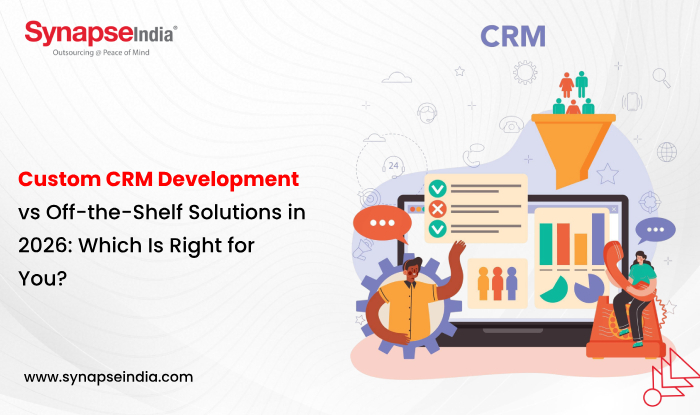
Custom CRM Development vs Off-the-Shelf Solutions in 2026: Which Is Right for You?
 08 Dec 2025
Quick Summary
Purpose: Help USA businesses select a CRM partner who can build systems that fit real workflows, customer processes, and long-term data needs.
Key Benefits: Cleaner customer data, smoother sales flow, faster follow-ups, better tracking, improved reporting, and stronger control over daily interactions.
Target Users: Small, mid-size, and growing USA businesses looking to upgrade, replace, or build a custom CRM that supports unique operations.
Main Factors to Check: Industry knowledge → CRM design skills → Integration experience → Clear build roadmap → Strong support after launch → Proven client success.
Selection Steps: List current gaps → Compare off-the-shelf vs custom → Shortlist companies → Check portfolios → Review costs/timelines → Test with a pilot → Finalize with clear terms.
Result: A CRM system that fits your workflow, reduces manual work, improves customer handling, and supports steady business growth.
Customer data works best when it fits your daily operations. In 2025, the global CRM market reached $97.90 billion (Demand Sage). The growth shows how businesses depend on CRM systems to manage customer interactions. The real question is: should your team use custom CRM development or choose an off-the-shelf tool?
Teams often struggle when a system forces them to change their process. Custom CRM development supports your exact workflow through focused CRM web development. Off-the-shelf tools help you start fast but may restrict how far you can go. By 2026, as AI becomes part of daily tasks, this choice matters even more.
What Is Custom CRM Development?
Custom CRM development begins with mapping your internal needs. Your team defines workflows, data points, and integrations. A custom CRM development company then builds a system around these requirements.
The approach allows direct support for special processes. For example, a logistics business may need real-time route inputs that common tools do not cover. Custom CRM development adds these functions at the start.
The outcome is a CRM that works naturally with your operations instead of forcing workarounds.
What Are Off-the-Shelf CRM Solutions?
Off-the-shelf CRM solutions come ready to use. Platforms like Zoho or Pipedrive include contacts, tasks, email tracking, and report settings. They help teams start within days, not months.
These tools work well for general workflows. The limitation appears when your process has unique steps. A non-standard quoting flow or multi-layer approvals may not fit correctly.
Off-the-shelf is fast, but less flexible for special business needs.
What Are the Key Differences Between Custom and Off-the-Shelf CRM in 2026?
Both options support customer data. The difference lies in fit, flexibility, and long-term direction. Here is a clear comparison:
- Custom CRM software development fits unusual workflows. Off-the-shelf may require your team to adjust to its structure.
- Custom CRM supports long-term growth without plan restrictions. Off-the-shelf increases cost per user and limits special additions.
- Custom CRM web development supports deep integrations with ERP or analytics tools. Off-the-shelf supports only common integrations.
As data volume grows in 2026, these differences affect speed, clarity, and team performance.
What Are the Pros and Cons of Each Option?
Below is a clean table showing both sides.
| Type | Pros | Cons |
| Off-the-Shelf CRM | Quick start within days | Limited customisation |
| Lower monthly entry cost | Higher costs with add-ons |
| Help articles and community support | Harder to switch later |
| Custom CRM | Built around your exact workflow | Longer build time (3–9 months) |
| Long-term savings after year two | Higher upfront cost starting near $50K |
| Full ownership and control | Needs ongoing technical support |
This simple view shows why small teams often begin with off-the-shelf, while growing companies move to custom CRM development.
What Are The Steps To Pick the Right CRM Path in 2026?
A clear method helps your team make the right decision. Here is a structured way to decide:
- Start with your must-have features such as mobile access, AI scoring, or workflow patterns.
- Review timelines. Short deadlines suit off-the-shelf. Longer timelines support custom CRM.
- Check three-year costs. Monthly subscriptions add up quickly.
- Test off-the-shelf with a trial. If it limits your flow, discuss custom options.
- Consider your 2026 growth plan. More teams, markets, or data may need custom flexibility.
Following these steps helps your team choose a system that supports your long-term operations.
Which CRM Trends Shape Decisions in 2025–2026?
Below is a table summarizing key industry numbers.
The data shows steady CRM growth and strong demand for systems that match business needs.
Why Should Businesses Consider Custom CRM in 2026?
Custom CRM software development fits teams that outgrow standard tools. It supports special funnels, multi-branch operations, or compliance-heavy processes without patches or adjustments.
Off-the-shelf works well for stable and simple requirements. However, high add-on costs and plan limits can become difficult over time. Custom CRM allows deeper AI support and stronger control over data.
Teams that switch to custom CRM often report better flow, fewer manual tasks, and cleaner data.
Why Choose SynapseIndia for Your CRM Software Development?
SynapseIndia supports businesses aiming to move away from restricted off-the-shelf systems. Our USA-based team builds CRM systems that match your real operations.
We begin with detailed process mapping, move into clean CRM web development, and support your system after launch.
We focus on clarity, structured planning, and predictable timelines. Our clients appreciate direct communication and consistent delivery without surprises.
Conclusion
A clear CRM choice depends on your process, pace, and long-term plan. Off-the-shelf works well for quick use, while custom CRM fits teams with special needs.
As 2026 brings more data and AI tasks, the right system supports smoother daily work. With the correct direction, your team gains better control and stable growth.
FAQs
1. How much does off-the-shelf CRM cost in 2026?
Basic plans start around $10–20 per user monthly and advanced plans can cross $50. A 10-person team often spends $6,000–12,000 yearly including add-ons.
2. When should a small business move to custom CRM?
Custom CRM suits teams that need special reports, multiple approval steps, or process-specific modules that off-the-shelf tools cannot support.
3. Can off-the-shelf CRMs support AI?
Many support AI scoring. Deeper AI features that depend on internal data work better in custom CRM.
4. How long does custom CRM take to build?
Most builds take 3–6 months depending on features. Teams often start with a simplified first version.
5. How does data migration work?
Data usually moves through CSV files or APIs. A structured field-mapping process avoids errors and downtime.
Jamie Lee
Master Degree in Computer Science with a focus on Open Source Technologies from UC Berkeley





 solutions@synapseindia.com


