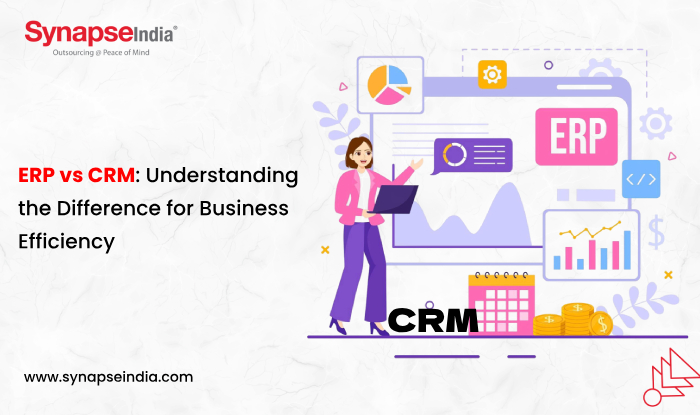
ERP vs CRM: Understanding the Difference for Business Efficiency
 19 Dec 2025
Quick Summary
- Purpose: Help organizations clearly understand the difference between ERP and CRM, how each system supports business efficiency, and when to use one or both in 2026.
- Key Benefits: Better control over internal operations with ERP, clearer customer visibility with CRM, reduced data gaps, smoother team coordination, and stronger decision-making.
- Target Users: Small, mid-sized, and large businesses managing finance, inventory, operations, sales, marketing, and customer support teams.
- Main Areas to Focus On: Internal process management (ERP) → Customer interaction tracking (CRM) → Data flow between systems → Team-specific usage → Reporting and visibility.
- Decision Steps: Identify business pain points → Review internal vs customer-related gaps → Involve sales and operations teams → Choose ERP, CRM, or both → Plan system connection.
- Result: The right mix of ERP and CRM that keeps operations organized, supports sales teams, improves data clarity, and helps the business grow with control.
In 2025, businesses are spending more on business software than ever before. The global ERP market alone is valued at US$55.88 billion (Statista), which shows how strongly companies are investing in better internal systems.
ERP and CRM are often discussed together, but they serve different purposes. ERP supports internal business operations, while CRM supports customer-related work like sales and support. Understanding this difference helps teams choose the right system at the right time.
Many companies work with an ERP software development services provider to connect finance, inventory, and HR into one system. Others partner with a custom CRM development company to support sales teams and customer communication. The right choice depends on where the business needs control first.
What is ERP?
ERP stands for Enterprise Resource Planning. It brings core business functions into one system.
ERP handles daily operational work such as accounting, payroll, inventory control, procurement, and supply chain tracking. All departments work with shared data, which reduces confusion and manual work.
Businesses usually move to ERP when growth creates gaps between teams. Separate tools for finance and stock often lead to errors. An ERP software development company can build a system that matches how departments already work.
ERP is mainly used by internal teams who need accurate numbers and clear process flow.
What is CRM?
CRM stands for Customer Relationship Management. It focuses on how a business talks to customers and prospects. The market is expected to reach USD 163.16 billion by 2030 (Grand View Research).
A CRM system stores contact details, tracks calls and emails, manages deals, and records support requests. Sales teams can see complete customer history before starting a conversation.
Many companies choose custom CRM development services to match their sales process. A custom CRM development company can add features like follow-up reminders, reporting dashboards, or marketing tool connections.
CRM is mainly used by sales, marketing, and support teams.
How ERP and CRM Differ in Daily Use?
ERP works inward. It connects departments so finance, operations, and HR stay aligned. Inventory updates help purchasing teams plan better, and payroll data supports workforce planning.
CRM works outward. It helps sales teams manage leads, follow up on deals, and track customer activity. Support teams use it to respond faster and stay organized.
Some areas overlap, such as order details. ERP controls order processing, while CRM shows order status to sales teams. Many companies use both systems together to keep data consistent.
| Aspect | ERP | CRM |
| Main Focus | Internal operations and resources | Customer relationships and sales |
| Key Users | Finance, HR, supply chain teams | Sales, marketing, support teams |
| Core Benefits | Better process control and cost tracking | Better sales follow ups and customer history |
This comparison shows a clear divide. ERP manages the back office. CRM manages the front office.
What Are The Key Differences Between ERP & CRM?
ERP and CRM differ across several core areas:
- Scope: ERP covers company-wide operations, while CRM focuses on customer-facing work.
- Primary Goal: ERP improves internal control, while CRM supports sales growth.
- Data Flow: ERP manages resources and costs, while CRM tracks customer activity.
- Typical Modules: ERP includes accounting and inventory, while CRM includes pipelines and campaigns.
Each system solves a different problem.
When to Choose ERP Over CRM (or Vice Versa)?
Choose CRM first when sales teams struggle with scattered customer data or missed follow-ups. CRM brings quick visibility into leads and deals.
Choose ERP first when internal issues slow the business down. Stock shortages, billing delays, or manual payroll are strong signs.
Many growing companies start with one system and add the other later. Using both together gives full control across operations and customer work.
Step by Step Guide to Deciding Between ERP and CRM
A clear decision comes from simple steps:
- List current problems and group them as customer-related or internal.
- Review existing tools and note where delays happen.
- Talk to sales, finance, and operations teams about daily issues.
- Set a realistic budget and rollout timeline.
- Speak with an ERP software development company or a custom CRM development company.
- Plan system connection if both tools are needed.
This approach avoids rushed decisions.
Why Choose SynapseIndia as Your ERP and CRM Development Partner?
At SynapseIndia, we build ERP and CRM systems based on real business processes.
Our team works with companies across the USA to support finance, operations, and sales teams with systems that fit daily work.
We focus on practical system design, clear workflows, and long-term usability. Our approach supports business growth without adding process complexity.
Conclusion
ERP and CRM solve different business needs. ERP controls internal operations, while CRM supports customer relationships and sales work. Together, they give teams full visibility across the business.
Many successful companies use both systems in connected form to keep data consistent and teams aligned.
FAQs
1. Can ERP and CRM be integrated?
Yes. Integration allows customer and order data to move between systems smoothly.
2. Is CRM part of ERP?
Some ERP tools include basic CRM features, but full CRM systems offer deeper sales and support tools.
3. Which is better for a small business: ERP or CRM?
Many small businesses start with CRM and add ERP as operations grow.
4. Do ERP and CRM replace each other?
No. They support different areas and work best together.
5. How much does custom development cost?
Costs depend on features, integrations, and scale. Custom systems reduce manual work over time.
Jamie Lee
Jamie Lee is a software writer with a Master's in Computer Science from UC Berkeley, specializing in open-source technologies. As a writer, Jamie brings a deep commitment to innovation and the democratization of technology.





.jpg)


 solutions@synapseindia.com


