MEAN Stack App Development: Benefits, Architecture & Use Cases
 03 Feb 2026
Quick Summary
- Purpose: Help businesses understand why MEAN Stack app development fits modern eCommerce and web applications in 2026.
- Key Benefits: Single-language development, faster updates, structured front-end control, real-time data handling, and lower setup costs.
- Target Users: eCommerce brands, startups, enterprises, and product teams planning new web platforms or system upgrades.
- Main Areas to Focus On: Unified JavaScript Stack → structured UI control → real-time APIs → flexible data storage → long-term code clarity.
- Preparation Steps: Review project scale → plan API structure → define front-end structure → choose deployment approach → test end-to-end flow.
- Result: A web application that stays manageable, adapts to change, and supports steady growth.
MEAN Stack app development continues to be a practical choice in 2026, especially for businesses building modern eCommerce and data-driven web applications. The main reason is simple. One language, JavaScript, runs the entire application from database to user interface.
This setup reduces context switching between tools and helps teams work faster without complexity. It also fits well with real-time features, flexible data handling, and structured front-end development.
In 2026, the demand for full-stack JavaScript solutions remains strong. One key market indicator shows that global IT spending reached $5.43 trillion in 2025 (Gartner), reflecting continued investment in web and application development.
What is MEAN Stack App Development?
MEAN Stack app development uses four open-source technologies that work together under JavaScript. These tools cover database storage, server logic, front-end interface, and runtime execution.
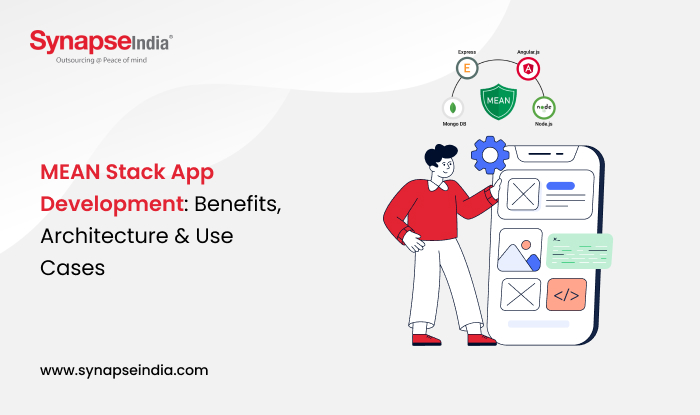
MongoDB handles data storage using flexible documents. Express.js manages server-side routing and APIs. Angular controls the front-end structure and user interactions. Node.js runs the back-end logic.
Because all layers use JavaScript, teams maintain one consistent codebase. This reduces friction between front-end and back-end work and supports faster coordination across development stages.
The MEAN Stack works well for applications that require live updates, structured interfaces, and steady feature expansion. The full stack development service market reached $150.27 billion in 2026 (Research And Markets).
What are the Benefits of MEAN Stack App Development?
MEAN Stack app development offers practical advantages that support both development teams and business goals. These benefits focus on clarity, speed, and long-term maintenance. The main benefits include the following points:
- One programming language across all layers reduces confusion and handoff issues.
- MongoDB stores data in JSON-like format, matching how Angular and Node.js handle data.
- Angular includes built-in tools for routing, forms, and state control.
- Node.js manages many user connections efficiently, supporting real-time features.
- Open-source tools reduce licensing expenses.
- Community resources help teams solve common issues faster.
Together, these benefits create a balanced environment for building eCommerce platforms, dashboards, and customer-facing systems. The stack supports change without forcing teams to rebuild core parts repeatedly.
How Does MEAN Stack Architecture Work?
MEAN Stack architecture follows a clear request-and-response structure. Each layer has a defined role, which helps keep applications organized and easier to manage.
User actions begin in the Angular front end. These actions trigger API requests sent to Express.js running on Node.js. The server processes logic and interacts with MongoDB to store or retrieve data.
Once the data operation completes, responses travel back through the same path. Angular updates the interface based on the returned data, keeping the user view current.
This architecture supports two-way data updates and works well for eCommerce systems that need live inventory changes, order updates, and user activity tracking.
Step-by-Step Guide to MEAN Stack App Development
MEAN Stack app development follows a structured workflow that helps teams build applications in a controlled way. The development process usually includes these steps:
- Set up MongoDB and define collections for application data.
- Create a Node.js project and configure Express.js routes.
- Build the Angular front end using components and services.
- Connect Angular with APIs through HTTP requests.
- Add authentication, validation, and error handling.
- Test the application and deploy it to a cloud platform.
This approach keeps each layer independent while allowing smooth communication between them. It also makes testing and updates easier as the project grows. Cloud-based web solutions account for 69.20% of the total web development market (Mordor Intelligence).
How To Choose a MEAN Stack Development Services Partner?
MEAN Stack development services often include planning, development, testing, and ongoing support. A structured service approach helps projects stay on schedule and aligned with business goals.
Professional teams focus on code clarity, documentation, and consistent review cycles. They also plan for updates and feature additions from the start.
For eCommerce platforms, this matters because payment flows, inventory systems, and customer data require careful handling across all application layers.
What are the Key Differences Between MEAN Stack vs MERN Stack?
MEAN and MERN are both JavaScript-based Stacks, but they differ mainly at the front-end layer. Understanding this difference helps teams choose the right fit.
| Aspect | MEAN Stack (Angular) | MERN Stack (React) |
| Front-end approach | Full framework with structure | Library-based approach |
| Language support | TypeScript included | JavaScript focused |
| Data binding | Two-way by default | One-way |
| Learning curve | Structured and strict | Easier for quick starts |
| Project fit | Large, organized teams | Fast-moving products |
MEAN Stack often suits projects that need consistency and long-term structure, especially in enterprise and eCommerce environments.
What is Enterprise MEAN Stack App Development?
Enterprise teams often prefer MEAN Stack app development because Angular enforces structure across large codebases. This helps teams follow shared patterns and coding rules.
TypeScript adds clarity by catching errors early during development. This reduces production issues and simplifies long-term maintenance.
For large eCommerce platforms, this structure supports multiple teams working on the same system without creating conflicts.
What are the Real-World Use Cases for MEAN Stack Apps?
MEAN Stack apps support a wide range of business scenarios. These use cases share common needs such as live data handling and structured interfaces. Common use cases include the following examples:
- eCommerce platforms with live inventory updates.
- Internal dashboards for sales and reporting.
- Customer portals connected to multiple systems.
- Content-driven platforms with frequent updates.
These applications benefit from MEAN Stack’s ability to manage data flow and interface updates in real time.
Why Choose SynapseIndia for MEAN Stack Development?
At SynapseIndia, we bring hands-on experience across planning, development, and long-term support for MEAN Stack projects. Our teams focus on clear communication, structured code practices, and steady execution.
We work closely with businesses to build eCommerce and web platforms that remain easy to manage as requirements change. Our approach supports clean data flow, organized front-end structure, and stable backend systems.
By aligning technical decisions with business goals, we help companies build MEAN Stack applications that support daily operations and future expansion without unnecessary complexity.
Conclusion
MEAN Stack app development provides a clear and structured way to build modern web applications. Using JavaScript across all layers reduces complexity and improves coordination between teams.
For eCommerce and enterprise platforms, this approach supports steady growth, easier updates, and long-term maintainability.
FAQs
1. What is MEAN Stack app development?
MEAN Stack app development uses MongoDB, Express.js, Angular, and Node.js to build full web applications using JavaScript across database, server, and front-end layers.
2. MEAN vs MERN: which is better?
MEAN suits structured, large-scale projects. MERN works well for fast-moving products. The right choice depends on team size, project complexity, and front-end preferences.
3. How much does MEAN Stack app development cost?
Costs usually range from $25,000 to $120,000 or more, depending on features, integrations, timeline, and team size.
4. Is MEAN Stack good for mobile app development?
MEAN works best for web apps. For mobile, Angular can pair with hybrid tools, while native mobile apps often use different frameworks.
5. What skills should a MEAN Stack developer have?
Strong JavaScript knowledge, Angular and TypeScript experience, Node.js and Express API skills, MongoDB handling, and familiarity with REST APIs and deployment workflows.
Lisa Chen
PhD in Artificial Intelligence from Carnegie Mellon University









 solutions@synapseindia.com


