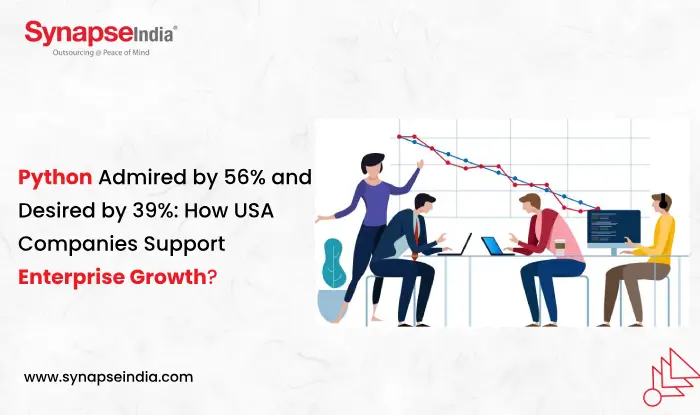
Python Admired by 56% and Desired by 39%: How USA Companies Support Enterprise Growth?
 23 Mar 2026
Quick Summary
- Purpose: Explain why enterprises across the USA are expanding Python development and how Python supports enterprise operations, automation, and eCommerce systems.
- Key Benefits: Clear programming structure, strong data processing tools, automation capability, artificial intelligence frameworks, and integration with enterprise systems.
- Target Users: Enterprise organizations, technology teams, retail companies, and businesses operating large eCommerce platforms.
- Main Areas to Focus On: Enterprise automation → analytics platforms → AI based applications → enterprise web systems → integration with business tools.
- Preparation Steps: Review operational processes → identify automation opportunities → start with pilot Python systems → expand across departments → refine systems based on operational needs.
- Result: Enterprises build systems that support better data visibility, automated workflows, and stable platforms that power internal operations and eCommerce activity.
Python continues to receive strong support from the developer community. Recent developer surveys show that 56% of developers admire Python and 39% want to use it in future work (Stack Overflow Developer Survey). This level of interest helps explain why enterprises across the USA increasingly build internal platforms and enterprise systems using Python.
Enterprise technology leaders now review programming languages from an operational perspective rather than only a technical one. They ask how a language supports business data, automation, enterprise platforms, and eCommerce systems.
Python often appears in these discussions because its structure allows teams to build applications that remain readable and manageable as systems expand. This characteristic matters for enterprise environments where software must operate for many years and support multiple departments.
A python development company in USA usually converts these technical strengths into enterprise platforms that process data, automate workflows, and connect business systems. As a result, many organizations use Python to strengthen their technology foundation while supporting business growth.
Why are Enterprise Leaders Asking More Questions About Python Development?
Technology evaluation today often begins with research style questions rather than simple product searches. Enterprise decision makers frequently ask questions such as:
- Why do enterprises use Python for enterprise software?
- How does Python support data analysis and automation?
- Can Python support enterprise platforms and eCommerce operations?
- What advantages does Python provide compared with other programming languages?
These questions reflect how enterprise leaders evaluate technology choices today. Instead of focusing only on development frameworks, they examine how a programming language supports operational systems and long term software maintenance.
Technology analyst Ray Wang, founder of Constellation Research, has often emphasized the importance of aligning technology with business operations.
“Digital transformation succeeds when technology supports how organizations actually operate rather than forcing companies to adjust to rigid systems.”
Python often supports this idea because development teams can create systems that match internal workflows. Technology publisher and open source advocate Tim O’Reilly has also commented on Python’s long term popularity.
“Python succeeds because it allows developers to express complex ideas in code that remains readable and maintainable.”
These perspectives explain why Python frequently appears in enterprise technology strategies.
What does Enterprise Python Development Actually Mean?
Around 57.90% of developers rely on Python (Statista). Enterprise Python development refers to building software systems using Python that support operations across departments within an organization. These systems often include internal web platforms, automation tools, analytics dashboards, and integrations between different business applications. Such systems help teams manage operations, analyze information, and coordinate activities across the organization.
Another important factor is maintainability. Enterprise systems often evolve over many years. Python’s readable structure allows development teams to update applications without creating confusion in the codebase. A best python development company in the USA typically focuses on building enterprise applications that integrate with accounting systems, inventory platforms, customer management tools, and eCommerce services. These integrations allow companies to move information between systems while maintaining clear data visibility.
How does Python Compare with Other Enterprise Development Languages?
Enterprises evaluating development technologies usually compare programming languages before selecting a platform. The following table highlights key differences between Python and commonly used enterprise languages.
| Factor | Python | Java | PHP |
| Code readability | Very clear structure that teams maintain easily | More complex syntax | Moderate readability |
| Data processing capability | Strong ecosystem of analytics libraries | Often requires additional frameworks | Limited advanced analytics tools |
| Automation development | Frequently used for workflow automation scripts | Possible but heavier implementation | Usually focused on web applications |
| Artificial intelligence tools | Widely used in machine learning frameworks | Smaller ecosystem | Rarely used for AI |
| Enterprise web applications | Supported through modern web frameworks | Common in enterprise systems | Primarily used for websites |
| Development speed | Faster prototyping and iteration | Longer development cycles | Moderate development speed |
Enterprise technology teams review these differences carefully when planning long term development strategies.
What are the Main Ways Python Supports Enterprise Growth?
Python contributes to enterprise development in several practical ways. Companies use the language across departments to improve data visibility, automate routine work, and build enterprise applications.
The following points explain how Python supports enterprise growth.
1. Python contributes to enterprise development:
Enterprises generate large volumes of operational and customer data. Python allows teams to process this information and create analytical models that support planning decisions. These systems help organizations evaluate product performance, customer activity, and operational trends.
2. Automation Reduces Repetitive Work:
Many enterprise tasks involve routine processes such as report creation, data updates, and monitoring systems. Python scripts can automate these tasks. Automation reduces manual work and allows employees to focus on strategic activities.
3. Artificial Intelligence Applications:
Python supports many frameworks used in machine learning and predictive analysis. Enterprises build recommendation systems, customer support tools, and forecasting models using these technologies. These applications help companies interpret data and improve decision making.
4. Enterprise Web Platforms:
Many organizations operate internal platforms that manage customers, products, and operational information. Python frameworks allow developers to build these platforms efficiently. Such systems frequently support internal operations as well as eCommerce services.
5. Integration Between Enterprise Systems:
Organizations often operate several technology platforms including finance systems, supply chain tools, and analytics platforms. Python helps connect these systems through APIs and automated data pipelines, allowing information to move consistently across the organization.
Together, these capabilities explain why many enterprises continue expanding Python development.
How do USA Enterprises Introduce Python into Business Systems?
Organizations usually introduce Python through a structured process that allows them to evaluate results before expanding systems across the organization.
The following approach is commonly used by enterprise technology teams.
1. Evaluate Operational Workflows
Technology teams begin by studying business processes to identify areas where automation or improved data processing would help. This evaluation helps organizations identify the most effective starting point for Python development.
2. Start With a Pilot Project:
Many companies begin with a small Python system such as an analytics tool or reporting platform. Pilot projects allow organizations to measure benefits before expanding development efforts.
3. Build a Dedicated Development Team:
Organizations often hire python developers in the USA who understand enterprise operations and large system development. Experienced developers help design applications that integrate with existing platforms.
4. Expand Systems Across Departments:
After a successful pilot project, organizations extend Python platforms across departments. Automation systems may connect with analytics dashboards, reporting tools, and eCommerce platforms.
This stage turns a small project into an enterprise level platform.
5. Continue Improving the Platform:
Enterprise systems evolve as organizations grow. Development teams continue improving Python applications by adding features and integrating additional business systems.
This gradual expansion supports long term technology development.
Why Choose SynapseIndia for Python Development?
Enterprises often partner with experienced development teams when building large software platforms. SynapseIndia works with organizations that require Python systems designed around real operational processes. Our teams build enterprise platforms that process data, automate workflows, and support eCommerce systems. We design architecture that remains manageable as organizations expand their technology infrastructure.
Companies that work with us often expand their platforms over time as new operational needs appear. Our experience with enterprise platforms helps organizations build software systems that support long term growth. Organizations planning to introduce automation tools, analytics systems, or enterprise platforms can work with our enterprise python development company in the USA to develop systems that support operational efficiency and eCommerce expansion.
Conclusion
Python has become one of the most widely discussed programming languages in enterprise technology discussions. Its readable structure, strong analytics tools, and automation capability make it useful for many business applications.
Enterprises across the USA continue expanding Python development to build enterprise platforms, automate workflows, and support eCommerce systems. As organizations focus more on data driven decisions and efficient operations, Python remains a practical technology choice for enterprise software development.
FAQs
1. Why do enterprises prefer Python for enterprise software development?
Enterprises prefer Python because its programming structure remains easy to maintain, supports strong analytics libraries, and allows teams to build automation systems and enterprise platforms efficiently.
2. Can Python support enterprise eCommerce platforms?
Yes. Python frameworks allow developers to build applications that manage product catalogs, customer data, order workflows, and analytics tools used in enterprise eCommerce systems.
3. How long does an enterprise Python development project usually take?
Most enterprise Python projects take between three and nine months depending on system complexity, integrations, and testing requirements.
4. Do enterprises use Python for automation?
Yes. Many organizations use Python scripts and applications to automate reporting tasks, monitoring systems, data processing workflows, and other internal operations.
5. Do companies need experienced developers for enterprise Python systems?
Yes. Enterprises usually hire developers experienced in data processing, system integration, and cloud environments to design and maintain enterprise Python platforms.
Emily Carter
MBA in Marketing from the University of Pennsylvania (Wharton School)





.jpg)






 solutions@synapseindia.com


