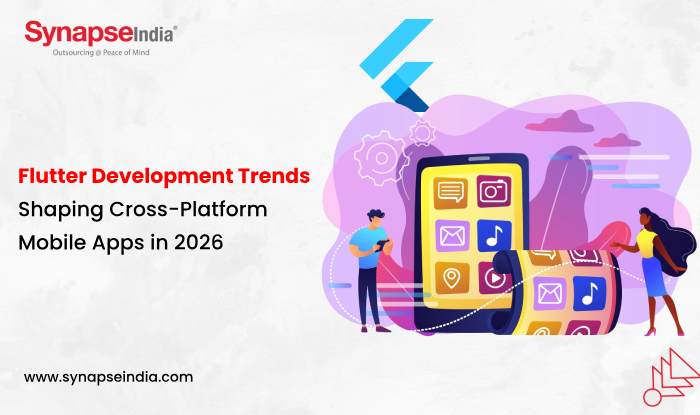
Flutter Development Trends Shaping Cross-Platform Mobile Apps in 2026
 23 Jan 2026
Quick Summary
- Purpose: Help businesses understand how Flutter supports cross-platform app development in 2026 and why a single codebase approach fits modern product needs.
- Key Benefits: Faster development, lower build cost, shared code across platforms, consistent user interface, and quick updates.
- Target Users: Startups, enterprises, product teams, digital businesses, and brands planning new mobile, web, or desktop apps.
- Main Areas to Focus On: Single codebase → Mobile and web support → Performance tuning → AI features → Ongoing updates.
- Preparation Steps: Review app goals → Choose Flutter SDK → Use updated packages → Test on all platforms → Set release process.
- Result: An app setup that supports faster launches, works across platforms, and stays ready for future growth.
By the end of 2026, nearly 50% of developers are expected to rely on cross-platform tools like Flutter, driven by faster development cycles and the need to support multiple platforms from a single codebase. In 2026, Flutter app development continues to lead this shift by enabling teams to build high-performance mobile, web, and desktop apps efficiently.
With constant framework upgrades like Flutter 3.38, businesses now build scalable apps without maintaining separate Android, iOS, and web codebases. This approach reduces cost, speeds up delivery, and ensures consistent user experiences across devices.
What is Flutter?
Flutter is Google’s open-source UI toolkit used to build natively compiled applications from a single codebase. It uses the Dart programming language and provides a rich set of customizable widgets.
Flutter allows developers to:
- Write code once and deploy it across platforms
- Build visually consistent interfaces
- Create smooth animations and complex UI interactions
- Deliver near-native performance
With strong community support and frequent updates, Flutter remains future-ready in 2026.
46% of developers choose Flutter for cross-platform development (Statista). Flutter changes app development by prioritizing shared logic and UI.
- Features are written once for Android, iOS, web, and desktop
- Flutter renders UI directly using its own engine, not native components
- Apps feel native while avoiding platform-specific rewrites
With hot reload, teams instantly see changes across platforms, reducing debugging time. Updates roll out faster because a single change applies everywhere.
In 2026, this efficiency makes Flutter development services a preferred choice for businesses aiming to scale without expanding development teams.
What Are the Top Trends in Flutter Development Services for 2026?
Flutter trends in 2026 focus on smarter apps, broader platform reach, and improved developer productivity.
- AI-powered Flutter apps: Flutter apps increasingly integrate AI-driven chatbots, recommendations, and automation using ML Kit and generative AI tools.
- Web and desktop-first development: Flutter 3.38 strengthens web support with better browser rendering, configuration-based debugging, and stateful hot reload across multiple browsers.
- Cleaner and faster code with Dart 3.10: Dot shorthand syntax (like .start instead of MainAxisAlignment.start) reduces boilerplate and improves readability.
- Performance optimization across devices: Framework updates improve scrolling behavior, reduce load times, and enhance stability on low-end and high-RAM devices.
- Stronger security and compliance readiness: Flutter continues to support encryption, secure storage, and compliance needs for industries handling sensitive data.
- IoT and device connectivity: Flutter apps increasingly connect with sensors, wearables, and smart devices using Bluetooth and IoT plugins.
- Low-code and faster delivery models: Flutter aligns well with low-code approaches, helping businesses ship apps faster with smaller teams.
These trends make custom mobile app development more flexible and future-proof in 2026.
How to Adopt These Trends Step by Step?
Adopting Flutter trends works best with a structured approach.
- Set up the environment: Install the latest Flutter SDK and Dart version.
- Start with a focused use case: Build a small app using AI features or cross-platform UI.
- Use updated packages: Choose stable plugins from pub.dev that support web, desktop, and IoT.
- Test across platforms: Validate apps on Android, iOS, browsers, and desktop systems.
- Upgrade regularly: Stay aligned with Flutter releases like 3.38 for performance and security improvements.
- Deploy using CI/CD pipelines: Automate testing and releases for faster time-to-market.
This approach helps teams adopt new capabilities without complexity.
Why Choose SynapseIndia for Custom Mobile App Development?
SynapseIndia brings deep expertise in Flutter development services and cross-platform app delivery. Our team builds scalable, secure, and performance-driven apps across mobile, web, and desktop platforms.
We focus on practical solutions that align with business goals, supported by experienced professionals and USA-based project coordination.
Connect with us to develop high-quality Flutter apps for 2026 and beyond.
Conclusion
Flutter continues to evolve as a powerful cross-platform framework in 2026. With updates like Flutter 3.38, improved web and desktop support, AI integration, and performance enhancements, it enables businesses to build future-ready applications efficiently.
Flutter’s growing ecosystem and strong community support ensure long-term value for modern app development.
FAQs
1. How does Flutter support long-term app maintenance in 2026?
Flutter uses a single codebase with regular framework updates, making bug fixes, feature additions, and platform upgrades faster and more manageable over time for growing cross-platform apps.
2. How does Flutter help reduce mobile app development costs in 2026?
Flutter lowers costs by using one shared codebase across platforms, reducing development time, testing effort, and long-term maintenance expenses for mobile, web, and desktop apps.
3. What makes cross-platform apps better in 2026?
They reduce development effort by supporting multiple platforms with a single codebase while maintaining performance and consistency.
4. How does Dart support Flutter trends?
Dart updates like dot shorthand and performance improvements make Flutter apps faster, cleaner, and easier to maintain.
5. Why choose Flutter over native development?
Flutter delivers near-native performance with lower costs, faster delivery, and easier scalability, ideal for growing businesses.
Mark Reynolds
Master Degree in Software Engineering from MIT





.jpg)




 solutions@synapseindia.com


