The Ultimate Guide to Laravel Application Development
 16 Nov 2023
Edited On: 29 Sep 2026
Quick Summary
- Purpose: Give businesses a genuinely useful breakdown of what Laravel is, why it still leads the PHP framework space, and how a professional build actually comes together, so you're not just taking a developer's word for it when scoping your next project.
- Key Benefits: A mature, security-first framework with a massive ecosystem (Eloquent ORM, Blade templating, Forge, Nova), strong performance at scale, and a talent pool large enough that staffing a project rarely becomes the bottleneck.
- Target Users: Founders, CTOs, and product leads evaluating frameworks for a new build, or businesses whose current PHP application has outgrown its original architecture.
- Result: A full picture of Laravel, its use cases, its development process, costs, challenges, and where it's heading, so you can walk into a conversation with a Laravel development company already knowing what good looks like.
Picking a backend framework isn't really about which one demos the best. It's about which one you'll still be happy with three years from now, when your team has grown, your traffic has grown, and "quick fix" isn't good enough anymore. That's usually where Laravel wins, not because it's new or flashy, but because it's had over a decade to get boring in all the right ways: stable, predictable, and hard to break by accident. This guide walks through what Laravel actually offers, what a real Laravel application development build looks like once you're past the sales pitch, and how a Laravel application development services company for USA clients should factor into that decision.
We're a custom web development company working almost entirely with clients across the US, the same logic behind software development outsourcing India more broadly: senior-level work at a fraction of the cost, without cutting corners on quality. If you're weighing an outsourcing partner in general, not just for Laravel, it's worth seeing what SynapseIndia offers across its full range of development services.
Why Do Businesses Still Choose Laravel in 2026?
Laravel has sat at the top of the PHP framework list for a while, and the numbers back it up. JetBrains' State of PHP 2025 survey found that 64% of PHP developers actively use Laravel, well ahead of Symfony at 23%. BuiltWith's independent tracking puts Laravel behind well over 1.5 million live websites worldwide, everything from scrappy startups to large enterprises.
That adoption isn't just a bragging point, it actually changes how a project goes. More developers using a framework means faster hiring when you need to scale a team, more battle-tested packages to lean on, and fewer moments where your team is the first one ever to hit a particular bug.
Taylor Otwell, the guy who built Laravel in the first place, has said as much himself over the years: the framework's staying power comes down to giving developers the practical tools modern applications actually need, not just a prettier syntax. You can see that philosophy baked into everything from how routing works to how migrations are handled.
Still weighing Laravel against something else? Our breakdown of Laravel vs other PHP frameworks covers where each one actually holds its own, and where it doesn't.
What Are the Core Features That Make Laravel Worth Building On?
A handful of things keep coming up when businesses explain why they picked Laravel over everything else for their laravel app development project.
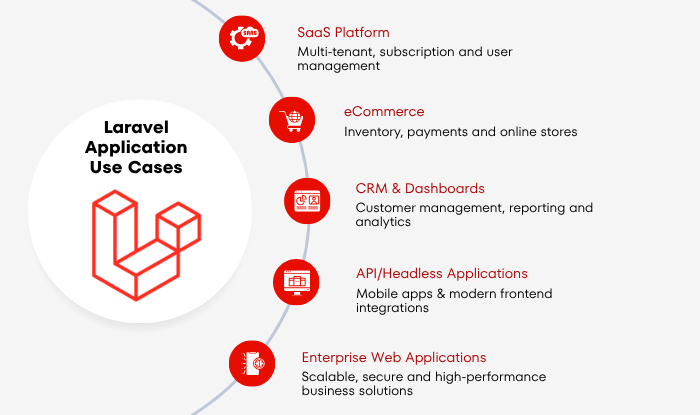
Eloquent ORM: Database work happens through clean, readable syntax instead of raw SQL scattered across your codebase, which matters a lot once the app grows past version one.
Blade Templating Engine: Lightweight, fast, and doesn't fight you when your frontend logic gets more complex.
Built-In Security: CSRF protection, encrypted sessions, hashed passwords, all standard from the start, not something bolted on later because a client asked.
Artisan CLI: Automates the repetitive stuff, migrations, seeding, testing, so developers spend their time on your product instead of boilerplate.
Ecosystem Tools: Forge for server management, Vapor for serverless deployment, Nova for admin panels. Fewer third-party tools duct-taped onto the stack.
Queue and Job Handling: Emails, notifications, report generation, all handled in the background instead of making your users wait.
Put together, this is what makes laravel web application development hold up so well over time, it's not one standout feature, it's how well all of these work together without fighting each other.
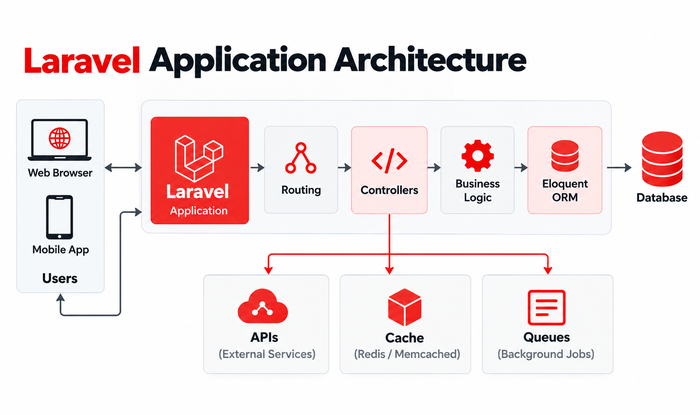
What Kinds of Applications Are Businesses Actually Building on Laravel?
Laravel doesn't lock you into one type of project. It bends to what the business needs underneath the surface.
SaaS Platforms
Multi-tenant setups, subscription billing, role-based access, all of it comes easier on Laravel than on most alternatives. Our case study on Laravel-built SaaS applications shows what that looks like once it's actually in production.
Business-Grade eCommerce
From inventory logic to secure checkout, Laravel handles the backend complexity a growing store eventually runs into. We go deeper into this in our guide to Laravel-powered eCommerce development for business-grade platforms.
Internal Tools and Dashboards
Custom CRMs, reporting dashboards, operational tools that need to talk to systems you're already running.
API-First and Headless Applications
More and more, Laravel powers the backend while a mobile app or JavaScript frontend does the talking, exposing clean APIs instead of rendering every page server-side.
Enterprise Web Applications
Larger companies lean on Laravel when they need something that can take real traffic without slowing down iteration.
How Does Laravel Stack Up Against Other PHP Frameworks?
This is usually the first real fork in the road for a CTO. Symfony trails Laravel by a wide margin in adoption, 23% versus 64%, and while it has its place in heavily modular enterprise setups, Laravel tends to win on speed of development and the sheer depth of its plugin ecosystem.
CodeIgniter and Yii still show up in older codebases, but neither has kept pace with Laravel's release schedule or community support. For the full side-by-side, our piece on Laravel compared against other PHP frameworks lays out where each one actually has an edge.
What Should You Look for in a Laravel Development Partner?
Not every agency with "Laravel" on their homepage has actually shipped anything meaningful with it. The gap between a team that's built one small site and one that's handled enterprise-grade platforms usually becomes obvious in the first real technical conversation.
Before you sign anything, it's worth reading through what actually separates a reliable Laravel development company from a risky one. Short version: ask how they handle testing, how they approach version upgrades, and whether you walk away owning the codebase outright once the project wraps. That last point matters even more when you're working with an offshore team, you want a partner running clean, transparent software development outsourcing india engagements, not one that quietly holds your code hostage.
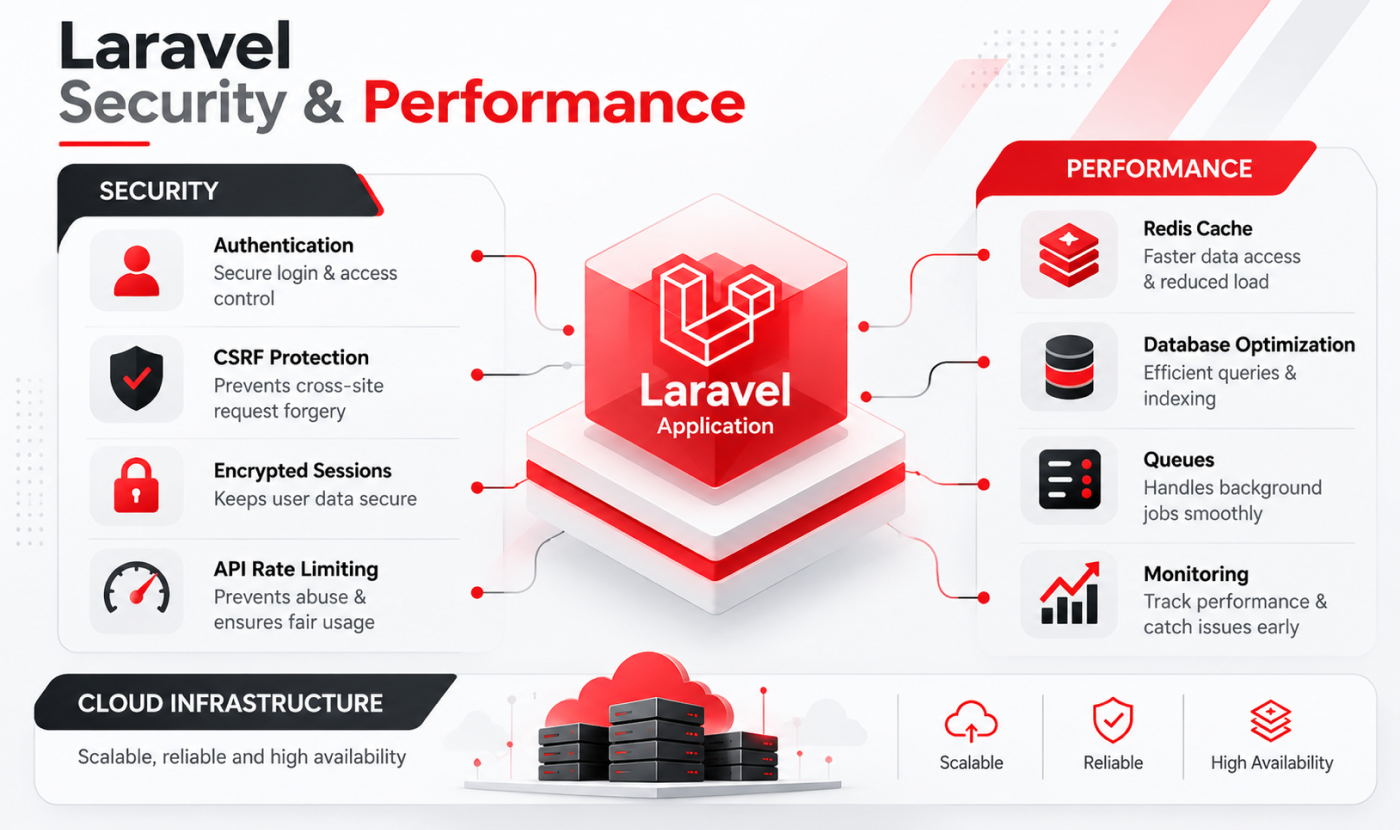
How Do Laravel Applications Stay Secure and Fast at Scale?
Security and performance don't get bolted on at the end, they need to be part of the build from day one. Laravel gives developers a solid starting point, but what happens with that foundation still comes down to the team writing the code.
Query optimization, proper caching (Redis is a common pairing), API rate limiting, regular dependency updates, these are the things that decide whether an app holds up once real traffic hits it. Our walkthrough of Laravel security and performance best practices covers the specifics most teams don't think about until something breaks. And if you're leaning on cloud infrastructure to handle scale, our piece on optimizing Laravel performance on Laravel Cloud is worth a read before you commit to an architecture.
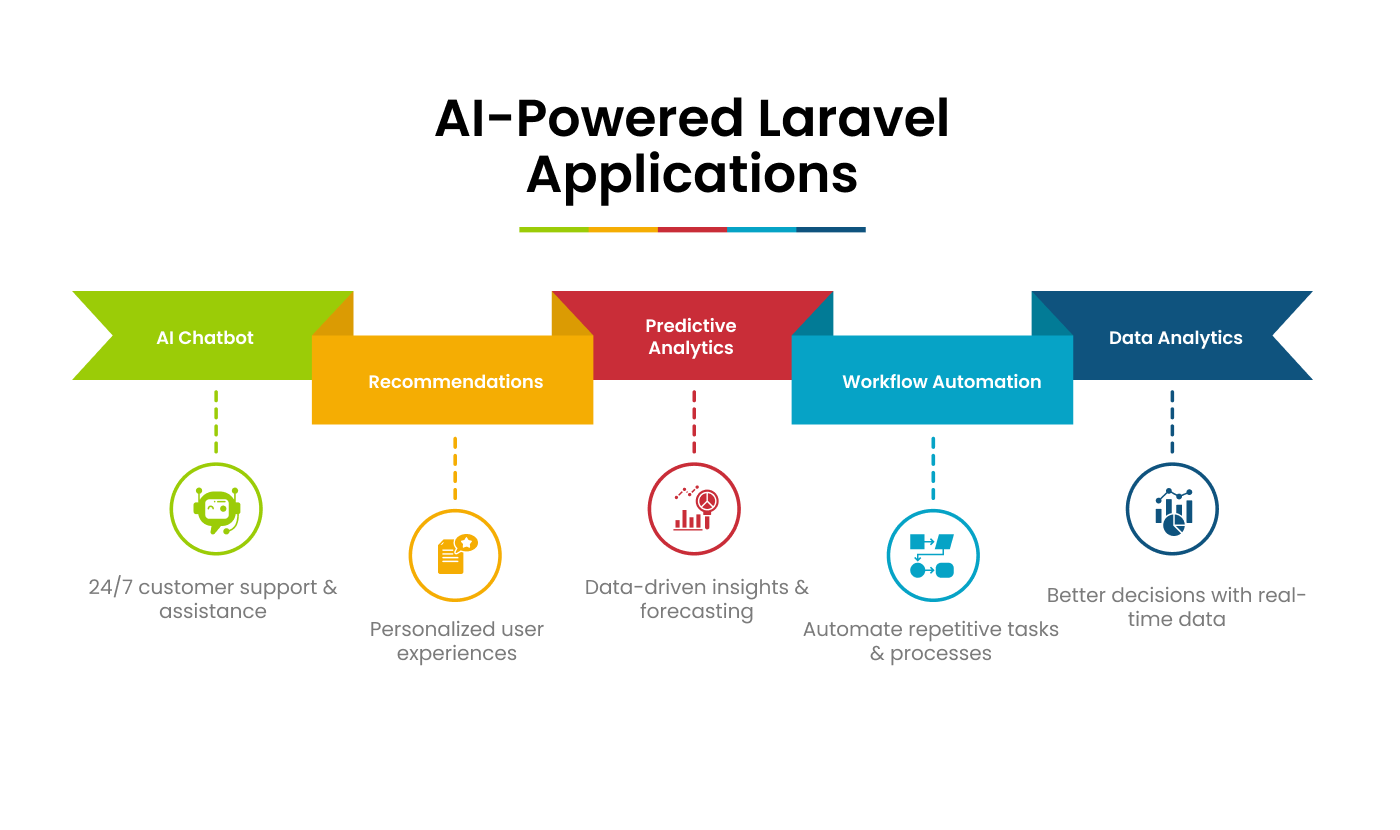
How Are AI and Emerging Tech Changing Laravel Development?
Laravel isn't standing still either. AI-assisted features, recommendation engines, predictive analytics, support automation, these are showing up more and more in Laravel builds, through both first-party tooling and outside integrations.
It's not just a trend for trend's sake. Businesses are using it to cut down manual work inside admin dashboards, personalize what users see, and process data faster than a rules-based system ever could. One of the more practical entry points is customer support, and our piece on integrating AI chatbots into Laravel applications covers how that's actually being done. For the bigger picture, see how AI and machine learning are being folded into Laravel applications more broadly.
Why Are USA Businesses Increasingly Choosing Laravel?
There's a reason CTOs at growing companies keep circling back to Laravel instead of chasing whatever framework is trending that quarter: it scales without forcing a rebuild, and it's stable enough that engineering leadership isn't constantly putting out fires. It's also why so many of them end up trusting delivery to the kind of laravel development company for USA-based teams that need speed without the local price tag, the developers themselves usually sitting a continent away, in a place like Noida, working their hours instead of their own.
We've unpacked this in more detail in our piece on why CTOs are choosing Laravel for scalable business applications in the USA, which digs into the specific pressures driving that decision at the enterprise level.
What Does Laravel Development Actually Cost, and How Long Does It Take?
This is usually where the real conversation starts. Cost depends heavily on scope, a simple internal tool looks nothing like a multi-tenant SaaS platform with custom billing logic, but there are patterns worth knowing before you sit down with vendors.
Timeline and budget both shift based on how much is custom logic versus how much can lean on existing Laravel packages. Our breakdown of Laravel app development cost and timeline expectations for USA businesses walks through realistic ranges by project type, so you're not walking into a quote blind.
Why Does Laravel Maintenance Matter After Launch?
Launch day isn't the finish line, it's closer to the start of the part that actually protects what you built. Laravel gets regular security patches and version updates, and applications that fall behind on either tend to rack up technical debt fast.
Skipping this is one of the more expensive mistakes businesses make after launch. We've laid out exactly why regular Laravel maintenance is essential for your web application.
What's New in the Latest Laravel Release?
Laravel's release cycle keeps moving, and each major version tends to bring real changes to performance, tooling, or developer experience, not just a fresh coat of paint. If you're running an older Laravel app, it's worth knowing what's changed before deciding whether to upgrade or rebuild.
Our rundown of what's new in Laravel 13 covers the major update in detail, including what it means for applications still sitting on earlier versions.
Conclusion
Laravel's staying power isn't an accident. It's what happens when a framework keeps getting better at the exact things businesses actually need, security, scalability, and a pace of development that doesn't come at the cost of code quality. Whether you're building a new SaaS platform, modernizing a legacy PHP app, or layering AI features onto something that already exists, the framework itself is rarely the limiting factor.
Partnering with an experienced custom web development company offering real Laravel application development services is what actually determines whether that scalability and security show up in your finished product, or just stay theoretical.
FAQs
1. Is Laravel still relevant in 2026?
More than relevant, it's still the framework most PHP developers reach for first. New projects keep landing on it, and that hasn't slowed down. If you're building something meant to stick around, it's a safe bet.
2. Why choose Laravel over PHP?
PHP leaves you building your own login system, your own database layer, your own security checks, all from scratch. Laravel already has solid versions of that built in. Most teams would rather not maintain custom infrastructure for years.
3. Will Laravel slow down as my application grows?
That's rarely on Laravel. Slow apps usually trace back to messy database queries or missing caching, not the framework. Handle those properly and Laravel holds up fine at scale, some fairly large platforms run on it.
4. My current app isn't on Laravel. Do I need to rebuild everything?
Not always. Sometimes yes, sometimes you can bring Laravel in gradually through APIs instead of tearing everything down. The honest answer only comes after someone's actually looked at your existing codebase.
5. How do I know if a team really knows Laravel, or just says they do?
Ask two questions: how they handle a major version upgrade, and what happens to your code if the contract ends. The answers tell you fast whether you're talking to someone experienced or someone guessing.
Priya Chandoliya
Priya Chandoliya is a professional blogger who specializes in building online communities. She has helped many of brands to increase sales, leads, and retentions. Priya has recognition of her write-ups across the globe. And Priya writes about how businesses can escape marketing mediocrity to achieve tangible results.














 solutions@synapseindia.com


