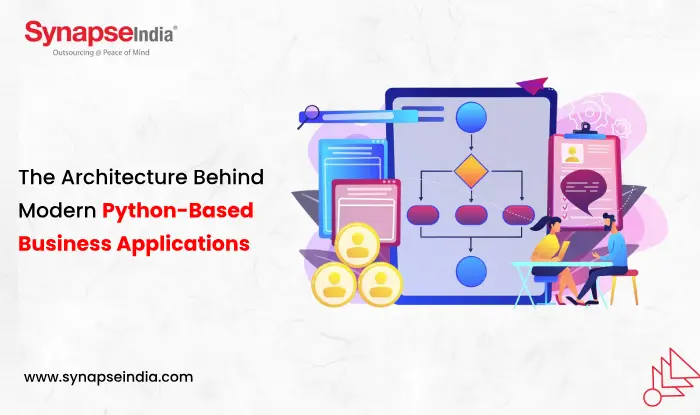
The Architecture Behind Modern Python-Based Business Applications
 21 Oct 2026
Quick Summary
- Purpose: To explain how a modern Python business application is structured, and what to decide before you build one
- Key Benefits: Python gives you a clean structure, quick delivery and room to grow. It also makes adding AI features easier later
- Target Users: Founders, CTOs and operations heads planning a custom app, or comparing a Python app development company with other options
- Result: A plain-language view of how Python applications are built, where they scale well and what to settle early
Most business apps don’t fail because of the programming language. They failed because nobody planned the structure underneath. Python application development works best when the architecture is clear from day one, and it gets messy when it isn’t.
This blog covers how modern Python apps are built, layer by layer. If you’re planning Python app development for a new product or a rebuild, it should help you ask better questions before you start.
Here’s what that looks like in a real project. For STEM City USA, a metaverse education platform, we built a Python and Django-based financial exchange system for reward points and secure transactions. It lifted user engagement by 30% in four months. You can read the full STEM City USA case study here.
How Does Python Work as a Backend for Business Applications?
Python runs the part of your app that users never see. It handles logins, payments, reports, notifications and the connections to your other software.
Most of the setup work is done by frameworks:
- Django is a full-stack framework with a built-in admin panel and database layer. It suits large web platforms, SaaS products and data-heavy apps.
- Flask is lightweight and allows freedom in the choice of architecture. Flask suits well for prototyping and specific tools.
- is async-first and built for fast APIs. It’s a strong fit for AI and machine learning backends.
Python also integrates easily with REST APIs, cloud platforms and most databases. If you already run on AWS, GCP or Azure, a Python app can connect to that setup without rewriting what you have.
The language keeps growing, too. Python’s adoption rose by 7 percentage points from 2024 to 2025 in the Stack Overflow Developer Survey, reflecting its role in AI, data science and back-end development. A larger community means more libraries, more tutorials and an easier time finding developers. (stackoverflow)
“Simple is better than complex.” - Tim Peters, Python core developer, in The Zen of Python
How Are Modern Python Applications Structured?
Most well-built Python apps use layers, and each layer does one job. That way, changing one part doesn’t break the rest.
| Layer | What It Does | Common Python Tools |
| Presentation | What users see and click | Django templates, React, Vue |
| API | Receives requests, returns responses | FastAPI, Django REST Framework |
| Business Logic | Your company’s rules and workflows | Python services and modules |
| Data | Stores and retrieves information | PostgreSQL, MySQL, Redis |
| Background Jobs | Runs slow or scheduled tasks | Celery, RabbitMQ |
| Infrastructure | Hosts, deploys and monitors | Docker, Kubernetes, AWS, Azure |
Give the business logic layer the most attention. When your pricing rules or approval steps live in one clear place, they’re easy to test and change. When they’re scattered across scripts and screens, every update becomes a risk.
Background jobs matter more than people expect. Sending thousands of invoices or building a monthly report shouldn’t freeze the screen for a user. A task queue handles that work quietly in the background.
Mobile works the same way. With Python frameworks like Kivy and BeeWare, a single codebase can power both iOS and Android apps. That keeps cost and development time lower than maintaining two separate native apps.
Can Python Handle Enterprise-Level Applications?
Yes. The usual worry is speed, and it’s a fair question. Python isn’t the fastest language at raw computation. But business apps spend most of their time waiting on databases, networks and other services, so the language is rarely the bottleneck.
The best example of this is Instagram. Its developers have described the platform as one of the largest deployments of the Django framework in the world, and Django is built entirely on Python. The reason for this choice was clear: Python offered a simple, readable syntax, faster development and a practical approach to building and scaling web applications. A small team could ship features quickly, keep the codebase easy to understand and grow the product as its user base grew. (Medium)
“Do the simple thing first.” - Instagram Engineering Team, on why they chose Python
Enterprise readiness comes from how you build, not just which language you pick:
- Split services where it makes sense, instead of one giant block of code
- Run automated tests before every release
- Cache data that gets requested again and again
- Add logging and monitoring so problems show up before customers see them
For heavier builds, we use Docker and Kubernetes with Django and Flask to deliver secure, scalable enterprise web applications. Newer Python releases are also improving parallel processing, which we cover in how Python 3.14 benefits AI and ML development.
What Is AI Employee Architecture in a Python App?
An “AI employee” is an AI agent that takes on a defined job inside your software. It might sort incoming leads, answer common support questions or draft reports, working alongside your team.
Python is the natural home for this. TensorFlow, PyTorch and scikit-learn all run on Python, so you aren’t bolting AI onto a language that wasn’t built for it.
In architecture terms, the AI agent is just another service in your system, and it needs rules:
- Clear permissions. It can read and write only what its job requires.
- Human checkpoints. Sensitive actions, like refunds, wait for approval.
- Logging. Every decision is recorded, so you can review it later.
- Fallbacks. If the AI service goes down, the rest of the app keeps working.
If you’re planning Python app development for AI/ML features, set these rules at the design stage. Adding them later costs more. Our AI and machine learning services cover this end to end.
How Do You Build Scalable Python Applications?
Scalable Python applications are built so that growth doesn’t force a rewrite. These habits help:
- Keep the app stateless. Store user sessions in a shared tool like Redis rather than on one server, so adding servers is easy.
- Plan the database early. Indexes, read replicas and caching prevent slowdowns before they show up.
- Use containers. Docker keeps every environment identical, from a developer’s laptop to production.
- Move heavy work out of the request. Reports, emails and file processing belong in background jobs.
- Start simple. A well-organised single application often beats a dozen small services nobody can keep track of.
Python supports microservices, async frameworks and cloud-native setups, so the same app can move from a few hundred users to millions without being rebuilt. That’s what keeps you from paying twice for the same feature.
What Should Businesses Consider When Designing a Python Application?
Before development starts, get clear answers to these questions:
- What problem does the app solve first? Build that well before adding extras.
- Which systems must it connect to? Your CRM, ERP, payment gateway and accounting tools all shape the design.
- How much will it grow in the next 2 to 3 years? Users, data and transactions all affect your choices.
- Who gets the source code? Check that the full source code comes to you.
- What happens after launch? Support, bug fixes, security patches and version upgrades should be written into the contract.
- Which industry rules apply? Healthcare, education, retail and travel apps each have their own compliance and integration needs.
A good Python app development company will ask most of these before giving you a price. If a team skips them, be careful. Our Python development team starts every project with them, and the cost is shared upfront based on your project’s scope.
What Sources Back Up the Numbers in This Blog?
Conclusion
Good Python architecture isn’t complicated. It’s clear layers, a business logic core you can trust, background jobs for heavy work and AI features added as controlled services. Get those right and the app grows with your business instead of holding it back.
We’re a Python app development company with 26+ years of experience, building custom web, enterprise and data-driven applications for businesses across the USA, UK and Australia. You get the full source code, a dedicated project manager and support after launch. If you’re planning a new build or fixing an old one, our team can review your plans and give you a straight answer.
FAQs
1. How does Python work as a backend for business applications?
Think of the backend as the engine room of your app. Customers never see it, but it’s where logins get checked, orders get saved and payments go through. Python developers usually don’t write all of this from scratch. They pick a framework like Django or FastAPI that already covers the basics, then build your business rules on top.
2. Can Python handle enterprise-level applications?
Yes, it can. Instagram is a good example, since it runs one of the biggest Django setups in the world. Big apps need good planning, regular testing and proper hosting, and Python works fine with all of that.
3. What should businesses consider when designing a Python application?
Start with the main problem the app should solve. Then list the tools it needs to connect with, like your CRM or payment system, and think about how much you want to grow. Also make sure the full source code comes to you and that support after launch is in your contract.
4. How are modern Python applications structured?
Most apps are built in layers. One layer shows the screens, one handles requests, one holds your business rules, one stores data, and others run background tasks and hosting. Each layer has its own job, so fixing or updating one part doesn’t mess up the rest.
5. Is Python a good choice for AI and machine learning features in a business app?
For most businesses, yes. The well-known AI tools, such as TensorFlow, PyTorch and scikit-learn, were built around Python. That means if you want your app to suggest products or predict demand, your developers can add it to the app you already have. You don’t need a second system or a different programming language just for the AI part.
Alex Johnson
Alex Johnson is a technology writer and Computer Science graduate from Stanford University. As a writer, he brings a genuine curiosity for the ever-changing world of technology.









 solutions@synapseindia.com


